
Home > Orthodontics > Braces
Updated: 08/29/2026 • Reading time 23 min
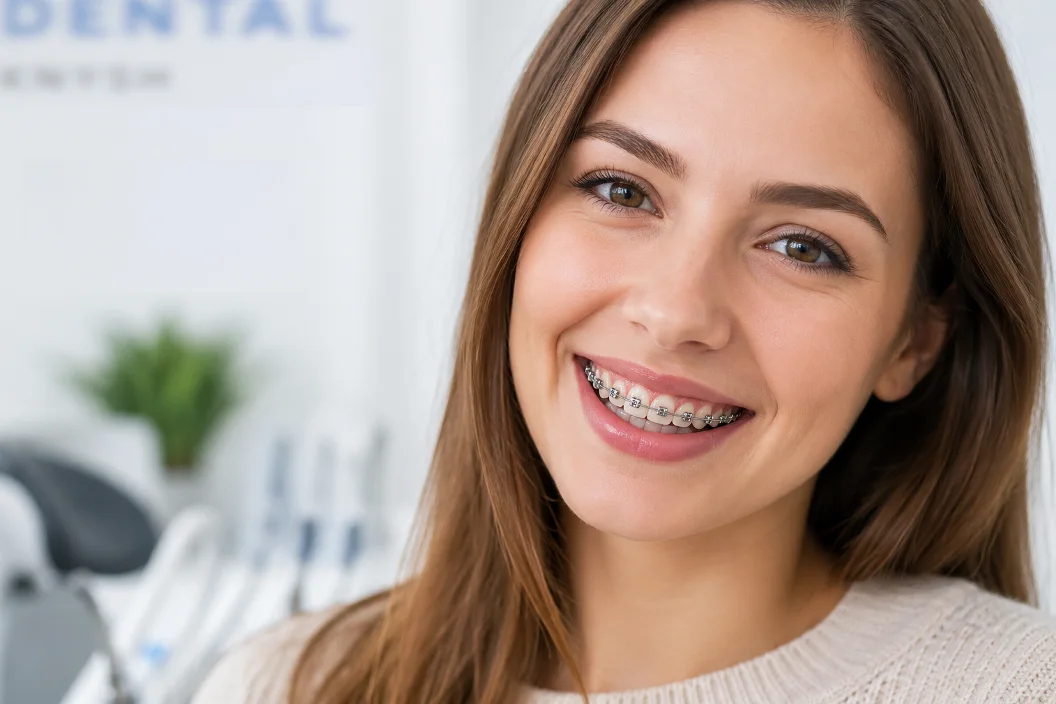
Orthodontic treatment with braces is a method used to correct the position of the teeth and bite in both teenagers and adults. According to the American Association of Orthodontists (AAO), age itself is not a barrier to orthodontic treatment – the condition of the teeth, gums, and supporting bone is more important.
Treatment with braces typically takes 12-24 months, although the duration depends on the complexity of the bite, the orthodontic system selected, and the individual response to treatment.
The cost of braces and the complete course of orthodontic treatment is determined individually after diagnostic assessment and preparation of a treatment plan.
CONTENTS
- What are braces?
- When are braces needed?
- At what age can you get braces?
- Types of braces
- Metal vs ceramic braces – which should you choose?
- Braces vs clear aligners
- Diagnostics before getting braces
- Stages of getting braces and orthodontic treatment
- How long do you need to wear braces?
- Does getting and wearing braces hurt?
- Dental care during orthodontic treatment
- What can and can’t you eat with braces?
- Retention after braces are removed
- Risks and possible complications
- Common concerns about braces
- Recommended videos about orthodontic treatment
- Frequently asked questions
- Cost of braces and orthodontic treatment
- Before and after treatment photos
- Orthodontists
- Patient reviews
What are braces?
Braces are a fixed orthodontic system used to gradually move teeth into planned positions and correct bite problems. The system consists of brackets attached to the surface of the teeth, an orthodontic archwire, and additional components used to apply controlled forces.
Under orthodontic forces, the teeth gradually move while the bone surrounding their roots remodels. The direction and rate of tooth movement are monitored and adjusted by an orthodontist during scheduled appointments.
Braces can be used to correct the position of individual teeth, crowding, gaps between teeth, and various bite problems. The appropriate treatment method is selected after orthodontic assessment, taking into account the condition of the teeth and gums, the bite, and the characteristics of the dentofacial system.
When are braces needed?
Braces may be recommended when the position of the teeth needs to be changed or the bite needs to be corrected.The need for orthodontic treatment is determined by an orthodontist after an examination and diagnostic assessment.
Common reasons for treatment with braces include:
- crowded teeth or insufficient space within the dental arch;
- significant gaps between teeth;
- incorrectly positioned or tilted teeth;
- upper or lower teeth that protrude excessively;
- deep bite, open bite, or crossbite;
- an improper relationship between the upper and lower jaws;
- the need to prepare tooth positions for prosthetic treatment or dental implants.
Not every bite problem necessarily requires braces. Depending on the patient’s age, clinical situation, and the complexity of the required tooth movement, an orthodontist may recommend braces, clear aligners, or another form of orthodontic treatment.
At what age can you get braces?
Braces can be used for both teenagers and adults, and there is no strict upper age limit for orthodontic treatment.The condition of the teeth, gums, periodontal tissues, and supporting bone is generally more important than age itself.
In children, orthodontic treatment may begin before braces are needed. During the mixed-dentition stage, the orthodontist evaluates jaw development and the eruption of permanent teeth and may recommend other orthodontic appliances when appropriate. Braces are generally placed once a sufficient number of permanent teeth have erupted. The optimal time to begin treatment is determined individually by the orthodontist.
Adults can also undergo treatment to improve tooth position and correct bite problems. Before treatment begins, it is particularly important to assess periodontal health and consider existing crowns, implants, missing teeth, and other dental restorations. When necessary, orthodontic treatment may be planned in cooperation with other dental specialists, such as a restorative dentist, periodontist, prosthodontist, or oral surgeon.
Therefore, the answer to “Am I too old for braces?” depends primarily on the individual clinical situation and diagnostic findings rather than age alone.
Types of braces
Braces differ in their material, design, and the way the orthodontic archwire is held in place. Metal and ceramic braces are among the most commonly used options, while braces can also be classified as conventional (ligature) or self-ligating according to the way the archwire is secured.
Metal braces
Metal braces are made from dental-grade metal alloys. They are a durable and widely used option for orthodontic treatment of varying complexity.
Their main characteristic is that they are clearly visible on the teeth. At the same time, metal brackets are relatively compact, resistant to mechanical forces, and allow the orthodontist to precisely control tooth movement.
Ceramic braces
Ceramic brackets are made from a material selected to closely match the natural shade of the teeth. As a result, they are less noticeable when speaking or smiling.
They are often chosen by patients who place greater importance on aesthetics during long-term orthodontic treatment. Ceramic braces require more careful handling because ceramic material is more brittle than metal.
Conventional braces
With conventional braces, the orthodontic archwire is held in the bracket slots using elastic or metal ligatures. During follow-up appointments, the orthodontist replaces or adjusts these components according to the current stage of treatment.
Self-ligating braces
With self-ligating braces, the archwire is secured without separate ligatures by a mechanism built into each bracket. Self-ligating systems may also be available in metal or more aesthetic materials.
Self-ligating braces are not automatically “faster” or “better” than conventional braces. The choice of system depends on the individual clinical situation and orthodontic treatment plan.
The most appropriate type of braces is selected by the orthodontist after diagnostic assessment, taking into account the bite, required tooth movements, aesthetic preferences, and the patient’s budget.
Metal vs ceramic braces – which should you choose?
Metal and ceramic braces are both used to move teeth orthodontically, but they differ primarily in appearance, material, durability, and cost. The choice between them depends not only on aesthetic preferences but also on the planned orthodontic treatment.
| Metal braces | Ceramic braces | |
| Visibility | Clearly visible on the teeth | Less noticeable and designed to blend with the teeth |
| Durability | High | Ceramic is more brittle |
| Size | Usually compact | Brackets may be slightly larger |
| Appearance | Traditional appearance of braces | More discreet aesthetic option |
| Care | Require thorough oral hygiene | Require thorough hygiene and careful handling |
| Cost | Usually lower | Usually higher |
Metal braces are often chosen when durability, functionality, and treatment cost are priorities.
Ceramic braces may be preferable for patients who want their orthodontic appliance to be less noticeable.
In some cases, a combination may be possible, with aesthetic brackets placed on the more visible teeth and metal brackets used in less visible areas. Whether this approach is appropriate is determined by the orthodontist.
Braces vs clear aligners
Both braces and clear aligners are used to move teeth and correct bite problems, but they are different orthodontic treatment systems. Braces remain fixed to the teeth throughout treatment, while clear aligners are removable transparent trays that patients can take out and put back in themselves.
| Braces | Clear aligners | |
| Design | Fixed appliance | Removable transparent trays |
| Visibility | Metal braces are visible; ceramic braces are less noticeable | Discreet and minimally visible |
| Patient compliance | The appliance works continuously | Aligners must be worn for the number of hours prescribed by the orthodontist |
| Eating | Braces remain on the teeth and certain foods need to be avoided | Aligners are removed before eating |
| Oral hygiene | Requires careful cleaning around brackets and wires | Aligners are removed for brushing and flossing |
| Treatment management | The orthodontist adjusts the appliance during appointments | The patient progresses through a series of aligners according to the treatment plan |
| Clinical applications | Can provide a broad range of orthodontic tooth movements | Suitability depends on the individual clinical situation |
Clear aligners are often chosen because they are discreet and can be removed for eating and oral hygiene. However, treatment success depends considerably on consistently wearing the aligners for the prescribed amount of time.
Braces do not require the same level of daily compliance because they remain attached to the teeth and can be used for a broad range of orthodontic treatment needs.
There is no universal answer as to whether braces or clear aligners are better. The most appropriate method is determined by the orthodontist after diagnostic assessment of the bite and the tooth movements required. If both options are clinically suitable, factors such as aesthetics, lifestyle, willingness to follow the prescribed wear schedule, and treatment cost can be considered.
Diagnostics before getting braces
Before braces are placed, an orthodontic assessment is performed to evaluate tooth position, the bite, the jaws, and to plan the required tooth movements. Braces should not be placed without appropriate diagnostic assessment and treatment planning.
The diagnostic process may include:
- examination of the oral cavity and bite;
- assessment of the teeth, gums, and periodontal tissues;
- photographs of the face and dental arches;
- digital scans of the teeth or diagnostic models;
- a panoramic dental X-ray;
- a cephalometric X-ray and analysis;
- when clinically indicated, cone-beam computed tomography (CBCT);
- assessment of tooth and root positions and the supporting bone.
The orthodontist determines the necessary examinations individually. Not every patient requires all of the tests listed above.
Based on the findings, the orthodontist prepares an individual orthodontic treatment plan, determining the required tooth movements, the most appropriate treatment system, and the estimated duration of treatment.
The mouth should also be prepared before braces are placed. If tooth decay, gum inflammation, or other dental problems are present, the necessary treatment is carried out first. Professional dental cleaning is generally recommended before the braces are fitted.
Stages of getting braces and orthodontic treatment
Treatment with braces involves much more than simply fitting the appliance – it is a sequence of stages extending from initial diagnosis to retention after the braces are removed. Each stage has a specific purpose and contributes to the final treatment result.
1. Orthodontic consultation
The orthodontist evaluates the position of the teeth and the bite, discusses the patient’s concerns and expectations, and considers possible orthodontic treatment options.
2. Orthodontic diagnostics
The necessary examinations, photographs, digital scans, or diagnostic models are obtained. The orthodontist analyzes the findings and develops an individual treatment plan.
3. Preparing the teeth and gums
Active dental problems should be treated before braces are placed. When necessary, tooth decay and gum disease are treated, professional dental cleaning is performed, and any other required dental procedures are completed.
4. Placement of the braces
The tooth surfaces are cleaned and prepared for bonding. A bracket is bonded to each tooth in its planned position, after which the orthodontic archwire is inserted.
Bonding braces does not require drilling into the teeth and is usually performed without anesthesia.
5. Active orthodontic treatment
The patient attends regular orthodontic appointments. During these visits, the orthodontist evaluates tooth movement, changes archwires, ligatures, or other components, and adjusts treatment according to the planned result.
The interval between appointments is determined individually depending on the appliance and the stage of treatment.
6. Removal of the braces
Once the planned tooth positions have been achieved, the brackets are removed and any remaining bonding material is carefully removed from the enamel.
7. Retention
After active tooth movement is complete, the result needs to be stabilized. Fixed retainers and/or removable retention appliances may be used for this purpose.
Retention is an integral part of orthodontic treatment. Without appropriate retention, teeth may gradually shift after braces are removed.
How long do you need to wear braces?
Orthodontic treatment with braces typically takes around 12-24 months, although the exact duration cannot be determined without diagnostic assessment. Simpler cases may be completed sooner, while more complex bite problems may require longer treatment.
Treatment duration can be affected by:
- the type and complexity of the bite problem;
- the initial position of the teeth;
- the amount of tooth movement required;
- the condition of the supporting bone and periodontal tissues;
- age and individual biological response;
- the selected orthodontic treatment plan;
- regular attendance at follow-up appointments;
- compliance with the orthodontist’s recommendations;
- broken brackets and other interruptions to the appliance’s function.
Faster tooth movement does not necessarily mean better treatment. Orthodontic forces need to be controlled because safe tooth movement requires gradual remodeling of the tissues surrounding the tooth root.
Once the braces are removed, the active phase of treatment is complete, but treatment continues with a retention phasedesigned to help maintain the teeth in their new positions.
Does getting and wearing braces hurt?
Having braces fitted is usually not painful because the brackets are bonded to the surface of the teeth without drilling or other invasive procedures. Discomfort is more likely to develop several hours later, once the orthodontic appliance begins applying force to the teeth.
During the first few days, patients may experience:
- pressure or tenderness in the teeth;
- discomfort when chewing;
- increased sensitivity when biting or pressing on the teeth;
- irritation of the cheeks or lips from parts of the appliance.
These sensations are associated with the beginning of tooth movement and the mouth adapting to the braces. The most noticeable discomfort usually decreases gradually over several days.
Temporary tenderness may also occur after routine orthodontic appointments when an archwire is changed or other parts of the appliance are activated.
Orthodontic wax can be used to protect the cheeks and lips from irritation. During the first few days, softer foods that require less chewing may also be more comfortable.
Severe pain, significant swelling, injury to the oral tissues, or discomfort that does not improve should not simply be ignored. In these situations, the patient should contact their orthodontist so that the appliance can be checked and the cause of the symptoms determined.
Dental care during orthodontic treatment
Oral hygiene requires particular attention while wearing braces because food debris and dental plaque can accumulate more easily around the brackets, archwire, and other components of the appliance. Inadequate cleaning increases the risk of tooth decay, gum inflammation, and areas of enamel demineralization around the brackets.
For daily oral care, an orthodontist may recommend:
- an orthodontic toothbrush or a regular soft-bristled toothbrush;
- a single-tuft toothbrush for difficult-to-reach areas;
- interdental brushes for cleaning beneath the archwire and around brackets;
- dental floss or specialized orthodontic floss;
- a water flosser as an additional hygiene aid;
- fluoride toothpaste, unless there are individual contraindications.
The teeth should be cleaned thoroughly from all sides, with particular attention to the areas above and below the brackets, along the gumline, and beneath the orthodontic archwire. After eating, it is useful to check whether food particles remain trapped around the appliance.
A water flosser can help remove food debris from difficult-to-reach areas, but it does not replace mechanical cleaning with a toothbrush or cleaning between the teeth.
Professional dental cleaning is also important during orthodontic treatment. The recommended frequency is determined individually according to oral health, the rate of plaque accumulation, and the quality of home oral hygiene.
If white or dark spots develop around the brackets, or if there is gum bleeding, swelling, or persistent bad breath, the dentist or orthodontist should be informed rather than waiting until orthodontic treatment is complete.
What can and can’t you eat with braces?
Braces do not require a strict diet, but very hard and sticky foods should be avoided because they can damage brackets, distort the archwire, or become trapped in the appliance. How food is eaten can be just as important as the food itself.
What can you eat?
After the initial adjustment period, most familiar foods can remain part of the diet. Comfortable options include:
- soups, cereals, and soft side dishes;
- eggs;
- fish and tender meat;
- dairy products;
- soft fruits and vegetables;
- pasta, rice, and other foods that are easy to chew.
During the first few days after braces are fitted or adjusted, softer foods may be more comfortable because the teeth can temporarily feel tender.
Foods that require caution
Foods that pose the greatest risk to braces include:
- very hard nuts;
- hard crackers and snacks;
- hard candies;
- lollipops if bitten or chewed;
- caramel, toffee, and other sticky sweets;
- popcorn;
- very hard bread crusts and other foods that require forceful biting.
Hard fruits and vegetables do not necessarily need to be completely avoided. Apples, carrots, and similar foods are better cut into small pieces rather than bitten into with the front teeth.
Similarly, meat should preferably be removed from the bone before eating rather than bitten directly from the bone.
Avoid chewing ice, pens, pencils, or other hard objects, as this can cause a bracket to detach or damage the archwire.
If a bracket comes loose or an archwire becomes distorted, the orthodontist should be contacted. A damaged appliance may not function as intended in the treatment plan.
Retention after braces are removed
Orthodontic treatment does not end when the braces are removed. A retention phase follows, with the purpose of keeping the teeth in their corrected positions. Without retention, teeth have a natural tendency to partially shift back or change position over time.
After active tooth movement, the periodontal tissues and supporting bone need time to adapt to the new positions of the teeth. In addition, tooth position can naturally change throughout life, even in people who have never undergone orthodontic treatment.
Retainers are used to help stabilize the result.
Fixed retainer
A fixed retainer is a thin wire bonded to the inner surfaces of the front teeth, making it virtually invisible when speaking or smiling.
Patients cannot remove or replace this type of retainer themselves. It requires careful oral hygiene and periodic dental checks.
If the retainer becomes detached from even one tooth, the orthodontist should be contacted.
Removable retention appliance
A clear retention tray is made to fit the position of the teeth after active orthodontic treatment has been completed. It is worn according to a schedule prescribed by the orthodontist.
At the beginning of the retention phase, the appliance may need to be worn for longer periods, with the schedule changing later. Following the prescribed schedule is important because inconsistent retainer use increases the risk of tooth movement.
In some cases, the orthodontist may use both a fixed retainer and a removable retention appliance.
How long does retention last?
There is no single standard duration for orthodontic retention. It depends on the original position of the teeth, the type of bite problem, the treatment performed, age, and other individual factors.
Modern orthodontic practice generally involves long-term retention, and in many cases retainers may be recommended for many years.
The orthodontist determines the appropriate type of retainer, wear schedule, and duration of retention.
Recommended follow-up appointments remain important even after active treatment has ended. The orthodontist can check tooth position and the condition of the retainer and adjust the retention plan when necessary.
Retention is not an optional extra procedure. It is the final stage of orthodontic treatment and is necessary to help maintain the treatment result over the long term.
Risks and possible complications
Orthodontic treatment with braces is a controlled process, but like other forms of dental treatment, it involves certain risks and requires regular professional monitoring. Many complications can be reduced or prevented through good oral hygiene, following the orthodontist’s instructions, and attending scheduled appointments.
Possible risks during treatment include:
- enamel demineralization and tooth decay, most commonly associated with plaque accumulation around brackets;
- gum inflammation and bleeding when oral hygiene is inadequate;
- irritation of the cheeks and lips from brackets or archwires, particularly during the initial adjustment period;
- detached brackets or damaged archwires due to excessive mechanical forces;
- changes in periodontal tissues, particularly when gum or periodontal problems existed before treatment;
- tooth root resorption – some patients may experience a degree of root shortening during orthodontic tooth movement;
- relapse or movement toward previous tooth positions after active treatment, particularly when retention instructions are not followed.
The risk of complications is assessed during the diagnostic stage. This is why the teeth, gums, roots, and supporting bone should be evaluated before braces are placed and monitored throughout treatment.
Severe pain, significant swelling, marked tooth mobility, injury to the oral tissues, or other unusual symptoms should be reported to the orthodontist.
Common concerns about braces
Before starting orthodontic treatment, patients often have concerns about pain, the appearance of braces, treatment duration, or possible damage to their teeth. Below are some of the most common concerns.
“Braces are very painful”
Having braces fitted is usually not painful. Tooth tenderness and pressure are more likely to develop several hours after the appliance is fitted or adjusted and generally decrease as the mouth adapts.
“Braces damage your teeth”
Braces themselves do not cause tooth decay. The main risk comes from dental plaque accumulating around the appliance. Thorough home care and professional dental cleaning are therefore particularly important during treatment.
“Braces will leave marks on my teeth”
White areas of enamel demineralization can develop around brackets when plaque remains on the teeth for prolonged periods. The risk can be significantly reduced through good oral hygiene and monitoring of the enamel during treatment.
“I’ll have to wear braces for many years”
Treatment duration varies between patients. Active treatment typically takes around 12-24 months, although simpler cases may require less time and more complex cases may take longer.
“I’m too old for braces”
There is no strict upper age limit for orthodontic treatment. The condition of the teeth, gums, periodontal tissues, and supporting bone is generally more important than age itself.
“My teeth will become crooked again after the braces are removed”
Teeth can change position after active orthodontic treatment. This is why fixed retainers and/or removable retention appliances are used after braces are removed. Following the prescribed retention plan helps maintain the treatment result.
Recommended videos about orthodontic treatment
Short videos can help patients better understand orthodontic treatment and what to expect at different stages.


Frequently asked questions
Can braces be fitted to only one dental arch?
In some clinical situations, this may be possible, but the decision should be made by an orthodontist after diagnostic assessment. The upper and lower dental arches function together, so moving teeth in only one arch can affect the way the teeth meet. When bite correction is required, treatment of both arches is often necessary.
Do teeth need to be extracted before getting braces?
Not for every patient. Tooth extraction may be considered when there is significant lack of space, severe crowding, or as part of a particular bite-correction plan. The decision is made only after orthodontic diagnostics and evaluation of the available treatment options.
Do wisdom teeth need to be removed before braces?
Not necessarily. The presence of wisdom teeth alone does not mean they need to be removed before orthodontic treatment. The orthodontist evaluates their position, condition, available space, and potential relevance to the treatment plan.
Can cavities be treated while wearing braces?
Yes. If tooth decay or another dental problem develops during orthodontic treatment, treatment should not be postponed until the braces are removed. In some cases, the orthodontist may temporarily remove part of the appliance to provide access to the tooth.
Can braces be attached to dental crowns?
In many cases, yes. Orthodontic brackets can be bonded not only to natural enamel but also to certain dental restorations using appropriate techniques and materials. Existing crowns are taken into account when planning treatment.
Can dental implants move during orthodontic treatment?
No. Unlike a natural tooth, a dental implant is integrated into the bone and cannot be moved orthodontically. If a patient already has dental implants, their positions need to be considered when developing the orthodontic treatment plan.
What should I do if a bracket comes loose?
Contact your orthodontist and arrange an appointment. If the bracket remains attached to the archwire and is not causing irritation, it can often remain in place until the appointment. Do not attempt to bond the bracket back yourself.
What should I do if the orthodontic wire is irritating my cheek?
Orthodontic wax can be applied temporarily to protect the soft tissues, and the clinic should be contacted for advice. Do not attempt to bend or cut the archwire without instructions from your orthodontist.
Can I play sports with braces?
Yes. Braces generally do not prevent physical activity. For contact sports, an orthodontist may recommend an orthodontic mouthguard designed to accommodate braces.
Can I have an X-ray or CT scan while wearing braces?
In most cases, yes. The doctor or radiologist should be informed about metal braces because they can produce artifacts on certain images. The appropriate imaging method is selected according to the diagnostic purpose.
What happens if I miss an orthodontic appointment?
Contact the clinic and reschedule for the earliest suitable time. Long gaps between follow-up appointments may interfere with the planned treatment sequence and potentially extend treatment duration.
Cost of braces and orthodontic treatment
The cost of orthodontic treatment involves more than the price of the braces themselves. The total treatment budget may include diagnostics, fitting the appliance, follow-up appointments, professional dental cleaning, removal of the braces, and retention.
Cost of braces and treatment
What determines the total cost of treatment?
The overall cost may depend on:
- the type of braces selected;
- treatment of one or both dental arches;
- the complexity of the clinical situation;
- the duration of orthodontic treatment;
- the number of follow-up appointments;
- whether additional orthodontic components are required;
- whether other dental treatment or professional cleaning is required;
- the type of retention used after the braces are removed.
For this reason, it is more useful to compare not only the initial cost of getting braces, but the estimated cost of the complete treatment course – from diagnostic assessment through the retention phase.
After orthodontic diagnostics, the orthodontist prepares an individual treatment plan and can provide a more accurate estimate of the expected treatment duration and cost.
Prices for the service “Correction of occlusion with braces” you can see here
Bracket systems for correcting tooth occlusion in DentalKnysh


Modern technologies

Achievement of a beautiful smile

Treat since 1989
The result of orthodontic treatment with braces at the DentalKnysh clinic will be a beautiful smile with healthy straight teeth.
Photo reports
Photo report: Alignment of teeth using the brace system in DentalKnysh, 2025-04-01


Photo report: Alignment of teeth using the brace system in DentalKnysh, 2024-08-27


Photo report: Alignment of teeth using the brace system in DentalKnysh, 2024-08-11


Photo report: Alignment of teeth using the brace system in DentalKnysh, 2024-08-12


Photo reports of intermediate results of treatment using braces 2024-01-31


Before, during and after treatment with braces 2024-01-31


Photo report of treatment using a self-ligating metal bracket system for a year + restoration of 12, 22 teeth 2023-05-06


You can see more photo reports with the results of treatment with brace systems in our clinic.
Visit us, make an appointment for a consultation
Orthodont DentalKnysh

DOCTOR-DENTALIST-ORTHODONTIST
Bonar Valeria Oleksandrivna
Specialization: orthodontics
Education: LNMU D.Halytsky
Languages: Ukrainian, English.
Rating: ♥️♥️♥️♥️♥️ 9.7 out of 10
Valeria Oleksandrivna has been working as an orthodontist since 2010. She has experience in treatment, teeth alignment and installation of braces and aligners. A dentist of the highest category with over 10 years of experience, a member of the Association of Orthodontists of Ukraine.
Reviews


How satisfied I am with the new orthodontist
In one month, the teeth became the way I wanted


Now I go to @dentalknysh to Valeria

More reviews about the work of DentalKnysh doctors on our Instagram
Leave an application right now, fix the prices, if they rise, and you, for example, can only be at the reception in a month, then the prices before the increase will apply to you.
Make an appointment for a consultation or an appointment
The favorable geographical location creates safe conditions for your stay, the clinic is surrounded on all sides by hills
We have a generator, so we carry out all procedures at the scheduled time.
Please fill out the form and click the “Send” button, the administrator or doctor will call you as soon as possible.
We process your personal data in accordance with the GDPR, мore details in the Privacy Policy

МИ НА GOOGLE МАПІ

DentalKnysh
License of the Ministry of Health of Ukraine: Серія АД №064304 від 09.08.2012

Infomation
Accepted payment methods:
Visa • Mastercard • LiqPay

Contacts
24 Vasyl Stus Street,
Lviv, Ukraine
We speak English
Phone / Viber / WhatsApp:
+38 063 67 98 196
Mon-Fri 09:00 – 20:00
Sut 10:00 – 15:00
© DentalKnysh Dental clinic